Pressure Line Filter Selection Guide
A hydraulic system depends on clean fluid to operate pumps, valves, cylinders and other components reliably. During normal machine operation, small particles can enter or develop inside the hydraulic oil. If these contaminants reach sensitive components, they can increase wear, affect valve movement and reduce the reliability of the complete hydraulic system.
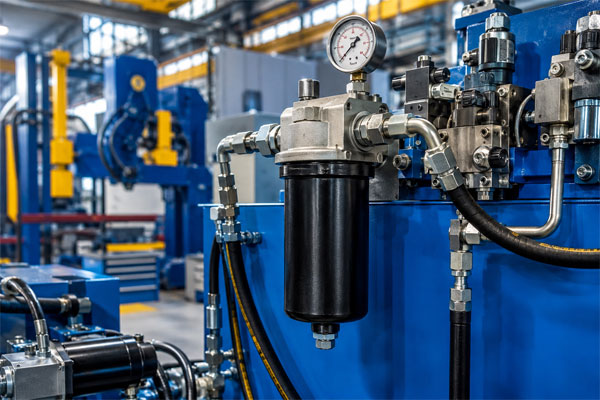
A pressure line filter is installed on the pressure side of a hydraulic circuit, normally after the hydraulic pump. Its main purpose is to filter the oil before it reaches important downstream components such as control valves, proportional valves, servo valves and cylinders. Because this filter operates on the pressurised side of the circuit, correct selection is important.
Choosing a pressure line filter only by connection size is not enough. Working pressure, flow rate, filtration media, micron rating, fluid type, temperature and element strength should all be considered.
What Is a Pressure Line Filter?
A pressure line filter is a hydraulic filter installed downstream of the pump in the pressure line.
Hydraulic oil leaving the pump passes through the filter before reaching sensitive downstream equipment. This allows the filter to capture contamination that may already be present in the fluid or may have been generated within the hydraulic system.
Pressure line filters are commonly used to protect components such as:
- Hydraulic valves
- Proportional valves
- Servo valves
- Hydraulic cylinders
- Manifolds
- Control blocks
- Other sensitive hydraulic components
Because the filter is installed in a pressurised line, its housing and filter element must be suitable for the system’s working conditions.
Why Is Correct Pressure Line Filter Selection Important?
Every hydraulic system has different operating conditions.
A filter suitable for one machine may not be suitable for another machine even when both use hydraulic oil.
Incorrect filter selection can lead to problems such as:
- Excessive pressure drop
- Restricted hydraulic flow
- Frequent filter element replacement
- Insufficient contamination removal
- Premature filter loading
- Incorrect connection with the pipeline
- Element damage under pressure
- Poor protection of sensitive components
A properly selected pressure line filter should provide the required filtration without unnecessarily restricting fluid flow.
For this reason, filter selection should be based on actual system data.
Check the Hydraulic System Working Pressure
Working pressure is one of the first parameters to check when choosing a pressure line filter.
Since the filter is installed on the pressurised side of the hydraulic circuit, the housing must be suitable for the system pressure.
Before requesting a filter, identify:
- Normal operating pressure
- Maximum system pressure
- Possible pressure peaks
- Filter installation location
Madhav Filtcare’s standard cast-body pressure line filter range is designed for medium-pressure hydraulic applications with a standard working pressure of 40 Bar.
If your hydraulic system operates outside the standard range, always share the actual pressure requirement before selecting a housing.
Never choose a pressure filter based only on physical dimensions.
Determine the Required Flow Rate
Flow rate is another major factor in pressure line filter selection.
The filter housing must allow the hydraulic oil to pass through at the required flow while maintaining acceptable pressure drop.
If a filter is too small for the required flow, it may create unnecessary restriction.
Before selecting a filter, check the hydraulic system flow rate in:
Litres per minute (LPM)
Madhav Filtcare’s current pressure line filter range covers operating flow rates from 10 to 1800 litres per minute, depending on the selected filter configuration.
When requesting a quotation, always provide both:
Working Pressure + Flow Rate
These two values help narrow down the suitable filter housing.
Select the Correct Connection Size
The filter connection should suit the hydraulic pipeline and required flow.
Standard pressure line filter connections may vary according to housing size and system requirements.
Madhav Filtcare currently offers standard pressure line filter connection sizes ranging from 1/2 inch to 2 inch.
Before ordering, confirm:
- Pipeline size
- Connection type
- Required orientation
- Available installation space
Do not automatically select a smaller filter just because its connection can be adapted to the pipeline.
Flow requirement should remain an important selection factor.
Choose the Right Filter Media
Filter media determines how contamination is captured.
The best media depends on required cleanliness, particle size, fluid condition and maintenance preference.
Different hydraulic systems may use different filtration media.
Paper Filter Media
Paper filter elements are commonly selected for general-purpose hydraulic and lubrication filtration.
They provide economical nominal filtration and are normally replaced after reaching their useful dirt-holding capacity.
Madhav Filtcare lists paper media options in 5, 10, 25 and 35 micron nominal ratings for its pressure line filter range.
Paper media can be suitable when the application does not require very fine absolute filtration.
Pressure Line Filter Media Comparison
| Filter Media | Filtration Type | Best Suited For | Reusable |
| Paper | Nominal | General hydraulic filtration | No |
| Glass Fiber | Absolute | Fine and critical filtration | No |
| SS Wire Mesh | Nominal | Reusable industrial filtration | Yes |
There is no single filter media that is best for every hydraulic system.
The correct media depends on your cleanliness target and operating requirement.
Understand Micron Rating Before Selection
A micron is a unit used to describe very small particle sizes.
The micron rating of a hydraulic filter indicates the particle size the filtration media is intended to control.
However, micron rating should not be selected by simply choosing the smallest available number.
A finer element can provide higher cleanliness, but system flow, viscosity, contamination load and pressure drop also need to be considered.
For example:
1–6 micron: Fine filtration for sensitive applications
10 micron: Common fine hydraulic filtration requirement
25 micron and above: General or coarser filtration depending on system design
The actual selection should always be based on the equipment requirements rather than this general classification alone.
Understand Nominal vs Absolute Filtration
When comparing filter elements, you may see two different filtration terms:
Nominal Filtration
Nominal filtration indicates that the filter removes a significant portion of particles around the stated size.
Paper and SS wire mesh media are commonly described using nominal micron ratings in Madhav Filtcare’s pressure line filter range.
Absolute Filtration
Absolute filtration is used where a defined high particle-removal efficiency at the stated micron size is required.
Glass fiber media is offered as the absolute-filtration option in Madhav Filtcare’s current range.
For sensitive hydraulic equipment, absolute filtration may be preferred when a specific oil cleanliness level must be maintained.
Check the Filter Element Collapse Rating
The filter element must also be able to withstand differential pressure.
As contamination collects inside the filter media, resistance to flow increases. The difference in pressure across the element can therefore rise.
The element construction must be strong enough for the intended system.
Madhav Filtcare lists a 30 Bar standard element collapse rating, with 60, 160 and 330 Bar options available on request for its pressure line filter range.
When selecting a filter element, discuss the expected operating conditions with the manufacturer rather than assuming that all elements have the same structural strength.
Confirm Hydraulic Fluid Compatibility
Not every filtration system handles every fluid in exactly the same way.
Before ordering a pressure line filter, identify the fluid used in the system.
Common examples include:
- Mineral hydraulic oil
- Synthetic hydraulic fluid
- Lubrication oil
- Other compatible industrial oils
Madhav Filtcare’s standard pressure line filters are listed for use with mineral oils, synthetic hydraulic fluids and lubrication oils.
For unusual chemicals, water-based fluids or special hydraulic fluids, confirm material and seal compatibility separately before ordering.
Consider Operating Temperature
Hydraulic oil viscosity changes with temperature, and filter materials also have operating limits.
Madhav Filtcare currently specifies a standard temperature range of -10°C to +100°C for its pressure line filter range.
If your application involves unusual heat, cold or process conditions, provide the actual working temperature when requesting the filter.
Temperature can influence:
- Fluid viscosity
- Seal selection
- Pressure drop
- Filter media performance
- Housing and element materials
This information is particularly important for industrial systems that operate continuously.
Choose Between Simplex and Duplex Pressure Line Filters
Pressure line filters can be supplied in different configurations.
Madhav Filtcare offers both simplex and duplex pressure line filter configurations.
Simplex Pressure Line Filter
A simplex filter uses a single filter housing.
It can be suitable for systems where the machine can be stopped during filter servicing or where continuous filtration is not required during maintenance.
Duplex Pressure Line Filter
A duplex filter arrangement provides two filtration paths.
This type of system can be useful where filtration needs to continue while one side is isolated for maintenance, depending on the design and installation.
For production plants where shutdowns are difficult, discuss duplex filtration with the manufacturer.
Consider Environmental and Corrosion Conditions
The filter housing may be installed in humid, dusty or chemically active industrial environments.
For such locations, housing surface protection can become important.
Madhav Filtcare offers standard finishes as well as corrosion-resistant surface coating options for pressure line filter housings.
Tell the supplier if your filter will operate in:
- Humid plant areas
- Outdoor locations
- Chemically active environments
- Process plants
- Wash-down areas
- High-dust manufacturing environments
The environment around the hydraulic system can influence housing protection requirements.
Consider the Application and Industry
Pressure line filters are used across many types of hydraulic machinery.
Madhav Filtcare lists applications including hydraulic power packs, machine tools, plastic and rubber processing machinery, textile machinery, press and stamping lines and general-purpose hydraulic circuits.
For industries in Ahmedabad and Gujarat, pressure line filters may support equipment used in:
- Engineering units
- Machine shops
- Manufacturing plants
- Hydraulic power pack systems
- Press machinery
- Processing equipment
- Production lines
The filter should always be selected for the actual machine rather than only the industry name.
Do Not Select a Pressure Line Filter Based Only on Price
Filter price matters, but it should not be the only selection factor.
A lower-cost filter that is incorrectly sized or uses unsuitable filtration media may cause more frequent maintenance and provide insufficient protection.
Compare:
| Selection Factor | What You Should Confirm |
| Working Pressure | Suitable for hydraulic line pressure |
| Flow Rate | Adequate for required LPM |
| Connection Size | Matches system piping |
| Micron Rating | Suitable for cleanliness requirement |
| Filter Media | Paper, glass fiber or SS wire mesh |
| Fluid | Compatible with filter and seals |
| Temperature | Within operating range |
| Configuration | Simplex or duplex |
| Element Strength | Suitable collapse rating |
| Housing Finish | Appropriate for environment |
A technically suitable filter normally provides better value than selecting only on purchase price.
What Information Should You Share with a Pressure Line Filter Manufacturer?
Before requesting a quotation, collect as much system information as possible.
Share:
- Hydraulic system working pressure
- Required flow rate in LPM
- Pipeline or connection size
- Hydraulic fluid type
- Required micron rating
- Preferred filter media
- Operating temperature
- Existing filter brand or part number
- Available installation space
- Required quantity
- Simplex or duplex requirement
If an existing filter is already installed, sharing photographs, nameplate information or an old element may also help.
Can an Existing Pressure Line Filter Element Be Replaced?
Yes, in many cases an existing hydraulic filter element can be cross-referenced or developed according to its dimensions, media and operating requirements.
If the original part number is known, share it with the filter manufacturer.
If the part number is not available, useful information can include:
- Outer diameter
- Inner diameter
- Overall length
- End-cap type
- Seal details
- Filter media
- Micron rating
- Existing sample
Madhav Filtcare also provides replacement filter elements and customised filter elements for industrial filtration requirements.
Pressure Line Filter vs Suction Strainer
These two products perform different functions in a hydraulic system.
A suction strainer is normally located on the pump suction side and helps prevent larger contaminants in the reservoir from reaching the pump.
A pressure line filter is installed after the pump and provides filtration before the hydraulic oil reaches downstream components.
| Feature | Pressure Line Filter | Suction Strainer |
| Location | Pressure side after pump | Suction side / reservoir |
| Main Purpose | Protect downstream hydraulic components | Protect pump from larger tank contamination |
| Filtration | Can provide fine filtration | Generally coarser filtration |
| Housing | Pressure-rated housing | Strainer construction |
| Typical Media | Paper, glass fiber, SS wire mesh | SS wire mesh |
Both may be used within the same hydraulic system because they perform different filtration duties.
How Do I Select the Right Pressure Line Filter?
Working pressure
Confirm the maximum pressure at the filter installation point.
Flow rate
Know how many litres per minute must pass through the filter.
Connection size
Check the hydraulic pipeline connection.
Micron rating
Identify the required oil cleanliness or equipment recommendation.
Filter media
Choose between paper, glass fiber and SS wire mesh based on filtration and maintenance needs.
After these details are known, fluid type, temperature, filter configuration and element strength can be checked.
Pressure Line Filter Manufacturer & Supplier in Ahmedabad, Gujarat
Madhav Filtcare & Hydraulics manufactures and supplies pressure line filters in Ahmedabad, Gujarat for hydraulic and lubrication applications.
The current range includes cast-body medium-pressure filters with simplex and duplex configurations, multiple filtration-media options and connection sizes from 1/2 inch to 2 inch. The range supports standard working pressure up to 40 Bar and operating flows from 10 to 1800 LPM.
Industrial customers in Ahmedabad, Gujarat and other regions of India can share their working pressure, flow rate, connection size and filtration requirements to discuss a suitable pressure line filter.
Frequently Asked Questions
The main details are hydraulic system working pressure, flow rate, connection size, fluid type, micron rating and operating temperature. The filter manufacturer may also ask about filter media, available installation space and simplex or duplex requirements.
A pressure line filter is normally installed downstream of the hydraulic pump in the pressure line. It filters the oil before it reaches sensitive valves, cylinders and other downstream components.
It depends on the application. Paper is suitable for general nominal filtration, glass fiber is used for finer absolute filtration and SS wire mesh is useful where a cleanable and reusable element is preferred.
The correct micron rating depends on the sensitivity of the hydraulic components, required oil cleanliness, contamination level and system design. Fine filtration should be selected according to the equipment requirement rather than simply choosing the smallest micron size.
A simplex filter uses one housing or filtration path. A duplex configuration provides two filtration paths and can be useful where the application requires greater maintenance flexibility or continued filtration during servicing.
Conclusion
Selecting the right pressure line filter for a hydraulic system requires more than matching the connection size. Working pressure, flow rate, micron rating, filtration media, fluid compatibility, operating temperature and filter configuration all need to be considered.
For sensitive hydraulic systems, correct pressure filtration can help control contamination before it reaches important downstream components.
If you are looking for a Pressure Line Filter Manufacturer & Supplier in Ahmedabad, Gujarat, Madhav Filtcare & Hydraulics provides hydraulic filtration solutions with paper, glass fiber and SS wire mesh filtration options for different industrial requirements.
Share your working pressure, flow rate, connection size and required micron rating with Madhav Filtcare & Hydraulics to discuss the right pressure line filter for your hydraulic system.