Paper vs Glass Fiber vs SS Wire Mesh: Choosing the Right Filter Element for High Pressure Applications
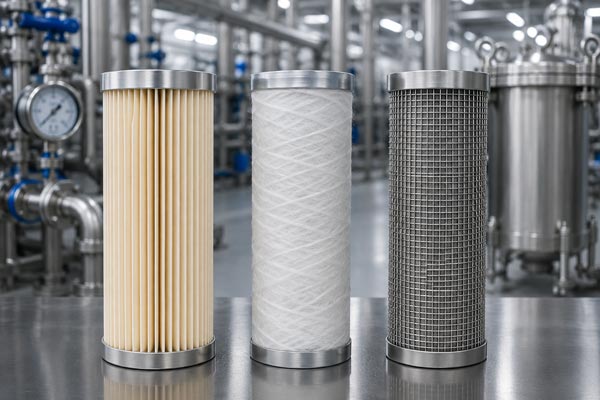
Choosing between paper, glass fiber and SS wire mesh filter elements comes down to four questions: what micron rating the circuit needs, how hot the fluid runs, what fluid is being filtered, and whether the element should be replaced or cleaned and reused. Paper elements suit lighter duty, budget conscious lines. Glass fiber elements deliver the finest and most consistent filtration available for high pressure hydraulic circuits. SS wire mesh elements trade fine filtration for a long, washable service life. Madhav Filtcare & Hydraulics manufactures and supplies all three types from Ahmedabad, Gujarat, so this guide walks through where each one earns its place on a machine.
Why Filter Media Matters More Than the Micron Number on the Box
Two filter elements can carry the same micron rating and still perform very differently once fluid is actually flowing through them. What separates a strong element from a weak one is whether that rating is nominal or absolute. A nominal rating describes filtration based on how much dirt the media removes by weight, with no fixed ceiling on the largest particle that can slip through. An absolute rating describes the largest particle the media will reliably stop, tested and repeatable batch after batch. That difference matters because contamination is the single biggest threat to a hydraulic system. Industry research published in Fluid Power Journal, credited to a research fellow at Cummins Filtration, puts the share of hydraulic failures traced back to fluid contamination somewhere between 75 and 90 percent. Getting the media choice right is not a small detail. It is most of the maintenance battle
Paper (Cellulose) Filter Elements
Paper elements are made from wood pulp or cotton fiber, and they remain the most widely used media for general purpose hydraulic and lubrication filtration because they are inexpensive and readily available. Their pore structure is uneven by nature, which is why cellulose media almost always carries a nominal rating rather than an absolute one, and why manufacturers rarely push a paper element below the 10 micron range with much confidence. Cellulose also reacts to its environment. It can swell when it absorbs moisture, and it loses structural strength as fluid temperature climbs, which shortens service life in hot running systems. On the plus side, that same moisture absorbing quality lets a paper element pull small amounts of free water out of a fluid stream, useful in return line positions where some water ingress is common. For general industrial equipment, agricultural machinery, and return line positions where pressure and precision demands are moderate, a paper element is a sensible, cost effective choice.
Glass Fiber Filter Elements
Glass fiber, sometimes called microglass or borosilicate glass media, is spun from molten silica into fibers far thinner and more uniform than cellulose. That uniformity is what allows glass fiber elements to carry an absolute efficiency rating, commonly in the range of 1 to 10 micron, with beta ratios that can run into the thousands rather than the single digits typical of paper. In plain terms, a higher beta ratio means the element traps a far greater share of particles at its rated size, and does so consistently rather than by chance. Glass fiber media also holds far more dirt before it needs changing, resists heat and most hydraulic fluids without degrading, and does not swell the way cellulose does when moisture is present. This is why glass fiber has become the default choice for high pressure lines protecting servo valves, proportional valves, and other precision components where a single oversized particle can cause real damage. Plants that upgrade from cellulose to glass fiber typically see their fluid cleanliness code improve substantially within the first few oil changes, since the runaway fine particle contamination that cellulose lets through gets stopped at the filter instead of circulating through the system.
SS Wire Mesh Filter Elements
Stainless steel wire mesh elements solve a different problem. Rather than chasing the finest possible micron rating, wire mesh media is built to be removed, washed, and put back into service instead of thrown away. That reusability, combined with resistance to heat and aggressive fluids, makes SS wire mesh the natural choice for basket strainers, protective screens ahead of a finer filtration stage, and applications where changing elements frequently is impractical or the fluid itself is abrasive or corrosive. The trade off is filtration precision. Wire mesh elements typically start around 40 micron and coarser, so they are rarely the only filtration stage on a sensitive hydraulic circuit. Instead, they usually work as a first line of defense, catching larger debris, scale, and wear particles before the fluid reaches a paper or glass fiber element downstream. The metal construction does push the upfront cost higher than paper or standard glass fiber cartridges, but for washable, long service applications, that cost is recovered over the element’s much longer working life.
How to Choose the Right Filter Element for Your Application
Start with what the machine’s original equipment manufacturer specifies, since pump, valve and cylinder warranties are usually tied to a minimum ISO 4406 cleanliness code. As a general guide, servo valve systems running above 200 bar typically need a target around ISO 16/14/11 or tighter, general industrial hydraulics using proportional valves usually target around ISO 17/15/12, and simpler systems using only directional control valves can often run acceptably at ISO 19/17/14. Once the target is known, work backward. A system that needs a tight cleanliness code has little room for a nominal rated paper element and will call for glass fiber, often paired with an SS wire mesh strainer ahead of it to protect the finer element from bulk debris. A system with a looser target and a lower duty cycle can often run on paper alone at a fraction of the cost. When in doubt, cross referencing the original filter part number against an OEM compatible replacement is the safest way to avoid a mismatch.
Comparing Paper, Glass Fiber and SS Wire Mesh at a Glance
| Filter Media | Rating Type | Micron Range | Reusable | Best Suited For |
|---|---|---|---|---|
| Paper (Cellulose) | Nominal | Generally 10 micron and above | No, replace only | Return lines, general industrial equipment, budget-sensitive systems |
| Glass Fiber | Absolute | Roughly 1 to 10 micron | No, replace only | High-pressure lines, servo and proportional valves, precision hydraulics |
| SS Wire Mesh | Nominal, Coarser | Generally 40 micron and above | Yes, washable | Strainers, pre-filtration, high-temperature or aggressive fluids |
A Manufacturer and Supplier of Filter Elements Based in Ahmedabad, Gujarat
Madhav Filtcare & Hydraulics manufactures and supplies paper, glass fiber and SS wire mesh filter elements from its base in Ahmedabad, and works with plants across the industrial belts of Vatva, Naroda, Odhav, Changodar and Sanand GIDC, along with units further out across Gujarat in Vadodara, Rajkot, Surat and Gandhinagar. Consider a typical fabrication or engineering unit operating out of the Vatva belt, running hydraulic presses across multiple shifts. A press line like that depends on getting the correct replacement element fast, since sourcing from an out of state supplier can mean a wait of several days once freight and dispatch time are added up. A local manufacturer and supplier that already stocks the common paper, glass fiber and SS wire mesh sizes, and that can cross reference OEM part numbers for the machinery common in Gujarat’s industrial clusters, cuts that wait down to a same day or next day turnaround in most cases. That is the practical advantage of sourcing filter elements locally rather than from a distant supplier unfamiliar with the equipment running on the shop floor.
Frequently Asked Questions
A nominal rating tells you how much dirt a filter removes by weight, with no guaranteed maximum particle size that can pass through. An absolute rating tells you the largest particle size the filter is proven to stop consistently. Glass fiber elements are usually absolute rated, while paper and standard wire mesh elements are usually nominal rated.
Not usually on their own. Wire mesh media is coarser, generally 40 micron and above, so it works best as a washable strainer or pre filter ahead of a finer paper or glass fiber element rather than as the sole filtration stage on a sensitive circuit.
This depends on the differential pressure indicator on the housing, the fluid’s contamination trend from oil sampling, and the manufacturer’s guidance for that specific element, so there is no single interval that fits every machine. A rising pressure drop across the filter is usually the clearest signal that replacement is due.
Yes. Replacement elements are cross referenced against original equipment specifications so the fit, micron rating and flow capacity match what the machine was designed for.
Yes. Alongside Ahmedabad and the surrounding GIDC estates, Madhav Filtcare & Hydraulics supplies filter elements to industrial units across Gujarat, including Vadodara, Rajkot, Surat and Gandhinagar.
Request the Right Filter Element for Your Machine
If you are not sure which filter element material fits your application, send Madhav Filtcare & Hydraulics your machine’s existing part number, or its operating pressure and fluid type, and the team will confirm the right paper, glass fiber or SS wire mesh replacement for it.
Call +91 84600 90233, email info@madhavfiltcare.com, or use the enquiry form on the website to request a quote.