Maximizing Hydraulic System Lifespan: A Guide to Preventative Maintenance and Filter Assembly Upgrades
Most hydraulic systems do not fail because a component simply wears out on schedule. They fail because contaminated fluid wears components out faster than it should, and by the time a pump or valve actually gives up, months of avoidable damage have already been done. Extending the working life of a hydraulic system comes down to three things done consistently: controlling contamination at the filter, matching filter assemblies and elements to what the OEM actually specified, and following a maintenance schedule that catches a problem while it is still cheap to fix. Madhav Filtcare & Hydraulics manufactures and supplies the filter assemblies, pressure line filters and elements behind all three, from its base in Ahmedabad, Gujarat.
Contamination Is Still the Leading Cause of Hydraulic Failure
The figure keeps showing up across independent research for a reason. Work published in Fluid Power Journal by a research fellow at Cummins Filtration attributes somewhere between 75 and 90 percent of hydraulic system failures to fluid contamination rather than any other cause. That statistic has held up because the underlying mechanism is simple and unforgiving. Hard particles circulating in hydraulic fluid abrade pump surfaces, score cylinder walls, and jam the fine clearances inside proportional and servo valves, and once wear debris starts entering the fluid, it generates more particles that cause more wear, a cycle that accelerates rather than levels off on its own. Stopping that cycle at the filter, before contamination reaches a working component, is the single highest leverage thing a maintenance program can do for system lifespan.
Reading the Warning Signs Before a Component Fails
A hydraulic system rarely fails without giving some notice first. Sluggish or delayed response in cylinders and actuators often points to internal wear or aerated, contaminated fluid. Whining, knocking or vibration from a pump usually signals cavitation, frequently caused by a restricted or clogging filter starving the pump of fluid. Rising operating temperature beyond what is normal for that system points to reduced lubrication or fluid breaking down under contamination and heat. Fluid that has turned cloudy, milky or noticeably darker than fresh oil is showing visible signs of water ingress or oxidation. Needing to replace or clean a filter more often than usual is itself a warning sign, since it often means something upstream is introducing contamination faster than normal: a failing seal, a damaged breather, or a housing that no longer isolates cleanly. Any one of these on its own is worth investigating. Two or more together are worth investigating immediately.
Setting an ISO 4406 Cleanliness Target for Your System
ISO 4406 is the standard most component manufacturers use to specify how clean a fluid needs to be, expressed as a three number code covering particle counts at 4, 6 and 14 micron per milliliter of fluid. The scale is logarithmic, so each step up in the code roughly doubles the particle count it represents, meaning a jump from a code of 17 to a code of 19 at the same size represents four times the contamination, not a small increase. As a practical target, servo valve systems operating above 200 bar generally need to hold around ISO 16/14/11 or tighter, general industrial hydraulics running proportional valves typically target around ISO 17/15/12, and simpler systems using only directional control valves can often run acceptably at ISO 19/17/14. Component manufacturers frequently tie their warranty terms to hitting a minimum cleanliness code, which makes this less of a nice to have and more of a condition for keeping that warranty valid.
Matching Filter Assemblies and Pressure Line Filters to the System
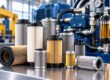
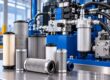
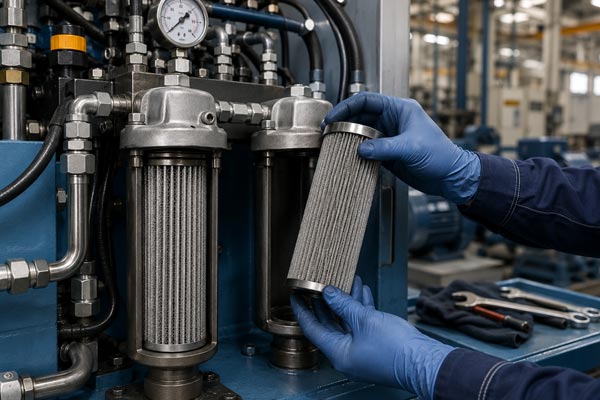
A filter assembly is the engineered housing, indicator and mounting hardware built around a filter element to protect a specific point in the circuit, whether that is the return line, the suction line, or the pressure line feeding sensitive components. Pressure line filters in particular are built to handle medium pressure applications in a cast housing, suited to both mineral oils and synthetic hydraulic fluids, sitting close to the components they protect so contamination is caught immediately before it reaches a valve or actuator. Matching the right assembly, and the right element inside it, to what the original equipment manufacturer specified protects more than filtration performance. An assembly that does not match the OEM’s flow rating, port size or pressure class can create its own problems, restricted flow, seal failure, or bypass under load, regardless of how good the filter media inside it is. When replacing a filter assembly, cross referencing against the machine’s original specification sheet or part number is the safest starting point.
Building a Preventive Maintenance Schedule That Actually Gets Followed
Daily and weekly: a quick visual check of fluid color and a glance at the filter’s differential pressure gauge catches the obvious problems early, before they become expensive ones.
Monthly: a fluid sample sent for particle count analysis tracks whether the system is holding its cleanliness target, improving, or drifting the wrong way. A single sample is only a snapshot, while a consistent monthly sample turns into a trend that actually predicts a coming problem.
Annually: a full inspection of seals, hoses and the filter housing itself catches wear that a monthly oil sample would not show on its own.
None of these steps require expensive equipment. What they require is consistency, since a preventive schedule that gets skipped during a busy production month is functionally the same as not having one at all.
Deciding When to Upgrade Rather Than Simply Replace
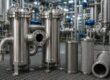
Not every worn filter needs a system redesign, but a few patterns are worth acting on rather than ignoring. If a paper element keeps clogging faster than expected and oil sampling shows the cleanliness code drifting the wrong way, moving to an absolute rated glass fiber element, covered in detail in our filter element comparison guide, usually solves the problem at the source rather than just replacing the symptom. If filter changes are interrupting a continuous line often enough to affect the production schedule, moving from a simplex to a duplex fabricated filter, covered in our guide to duplex filters, removes the stoppage entirely rather than just making it more frequent. And if an SS wire mesh strainer is being asked to do a finer job than its rating allows, adding a proper filtration stage downstream is usually cheaper than replacing the strainer more often and hoping it catches more than it is built to.
A Manufacturer and Supplier Supporting Hydraulic Systems Across Ahmedabad and Gujarat
Madhav Filtcare & Hydraulics has supplied hydraulic and lubrication filters, filter elements and strainers from Ahmedabad since 2016, originally as M Square Hydraulics before taking on its current name in 2026. That history means the team has already cross referenced filter assemblies for the machinery common across Gujarat’s industrial base, from press lines and compressors in Vatva, Naroda, Odhav, Changodar and Sanand GIDC, to plants further out in Vadodara, Rajkot, Surat and Gandhinagar. A defence, power, petrochemical, steel, cement, paper, plastic or automotive plant anywhere in that footprint can get a filter assembly matched to its exact machine, not a generic size that happens to fit the port.
Frequently Asked Questions
Monthly sampling is the common baseline for most industrial systems, since a single sample only shows a snapshot, while a consistent monthly trend shows whether contamination is improving, holding steady, or building toward a failure.
It is a three number code that reports how many particles of 4, 6 and 14 micron and larger are present in each milliliter of fluid. Lower numbers mean cleaner fluid, and because the scale is logarithmic, even a small increase in the code represents a much larger jump in actual particle count.
Yes. An undersized, mismatched or degraded filter assembly can restrict flow, allow bypass under load, or fail to hold the required cleanliness code, and a pump running on contaminated fluid wears out far faster than one protected by a correctly specified assembly.
Madhav Filtcare & Hydraulics manufactures and supplies OEM compatible filter assemblies, pressure line filters and elements from Ahmedabad, serving Gujarat’s industrial belt including Vatva, Naroda, Odhav, Changodar, Sanand, Vadodara, Rajkot and Surat.
Does Madhav Filtcare & Hydraulics give system specific recommendations, or only sell standard parts?
System specific recommendations. Sharing your machine’s existing filter part number, operating pressure and fluid type lets the team confirm the correct assembly and element rather than guessing from a catalog size.
Talk to the Team About Your System
Explore the full Filters range for assemblies, pressure line filters and fabricated filter options, or send Madhav Filtcare & Hydraulics your system’s details for a specific recommendation.
Call +91 84600 90233, email info@madhavfiltcare.com, or submit an enquiry through the website.